

Do Lladró Limited Editions Increase in Value?
Last Updated: November 8, 2026
Quick Summary
Lladró limited editions sometimes increase in value, but far less reliably than most buyers assume. A limited edition number signals scarcity, not guaranteed appreciation; whether a piece gains value depends on edition size, condition, documentation, and genuine collector demand, and many limited editions resell below their original retail.
- Edition size sets the ceiling on supply, not the floor on price.
- A modest edition with strong demand and complete paperwork typically outperforms a tiny edition with a thin collector base.
- Compare the percentage change in realized price against inflation to judge real returns.
- Lladró resale value is almost always lower than retail at the moment of purchase.
- Look for confirmed low edition size, confirmed retirement, certificate, and recognized sculptor before committing.
Table of Contents
- The Short Answer on Lladró Limited Editions and Value
- How to Value a Lladró Figurine Before You Pay a Premium
- Limited Edition, Open Edition and Retired: Three Different Markets
- Lladró Limited Edition Price History and What Realized Prices Show
- Most Valuable Lladró Figurines Share the Same Traits
- Lladró Resale Value: Costs, Condition and the Buy-Sell Gap
- Choosing Limited Editions With Genuine Collector Demand
- Explore the High End Collectibles Lladró Collection
- Frequently Asked Questions
The Short Answer on Lladró Limited Editions and Value
Do Lladró limited editions increase in value? Sometimes, and far less reliably than most buyers assume. A limited edition number on the base is a signal of scarcity, not a promise of appreciation.
The distinction matters because Lladró limited editions sit at the center of serious collecting. Scarcity creates potential, but only demand converts that potential into price. Below, we break down how to value a figurine, what realized prices actually show, and which traits separate a piece that holds value from one that simply costs more.
How to Value a Lladró Figurine Before You Pay a Premium
Valuation starts with identification, not admiration. Before you pay a premium for any limited edition, confirm what the piece is, when it was made, and what came with it.
Lladró valuation is the process of establishing a figurine's market worth by matching its marks, model number, edition size, condition, and documentation against comparable realized sales. Asking prices tell you what sellers hope for; sold prices tell you what the market pays.
Marks, Model Numbers and Documentation That Decide Price
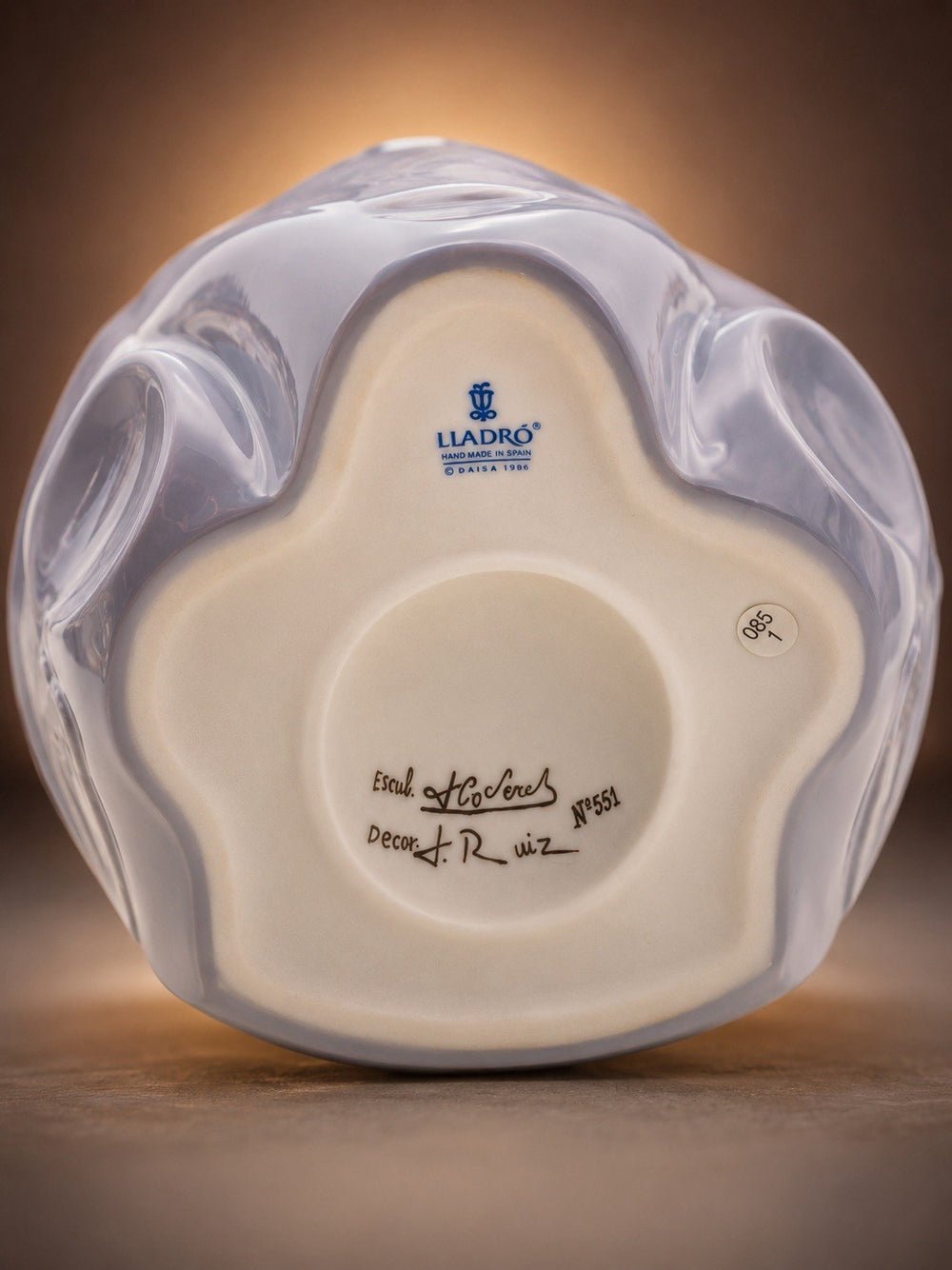
Lladró pieces carry identifying marks, and each one can bear on price. Check these before you commit:
- The Lladró maker's mark on the base, consistent with the production era
- The model number, matching the piece you believe you are buying
- A sculptor's signature where the edition included one
- The edition number, confirming the piece falls within the stated production run
- Original box and any certificate of authenticity
- Original paperwork and any provenance records
A low edition number is not automatic proof of quality. A complete example with documentation can be easier to insure and to resell.
Limited Edition, Open Edition and Retired: Three Different Markets
These three categories behave differently, and confusing them is the most expensive error in Lladró collecting. A limited edition is capped at a stated number of pieces, after which production stops. An open edition stays in production with no fixed cap, so supply keeps flowing. A retired figurine has ended production, but retirement alone says nothing about how many were made.
That last point deserves emphasis. Retirement is a production fact. Rarity is a supply fact. A retired open edition may exist in large numbers and trade modestly, while a low limited edition with documented retirement carries real scarcity. The more useful exercise is to compare how each category actually resells.
Why a Low Edition Number Does Not Automatically Mean Appreciation
Edition size sets the ceiling on supply, not the floor on price. Three forces decide whether a small production run converts into value:
- Surviving examples. Porcelain is fragile. Pieces are lost to breakage, house moves, and estate clear-outs over decades, so the number still intact can fall below the stated edition. A smaller surviving population tightens supply, but only if buyers are still looking.
- Collector demand. A closed edition of a subject few collectors pursue remains scarce and unsought. Scarcity without demand produces a low price and a long time on market.
- Documentation survival. Boxes, certificates, and provenance are discarded far more often than figurines are. A complete example can command more confidence, and a wider buyer pool, than a bare piece from the same edition.
The interaction matters more than any single factor. A modest edition with strong demand and complete paperwork will typically outperform a tiny edition in a subject with a thin collector base.
Comparing the Three Categories Side by Side
| Category | Supply | Production Status | What Drives Resale |
|---|---|---|---|
| Limited edition | Fixed at stated edition size | Ends at cap | Edition size, surviving examples, demand, documentation |
| Open edition | Ongoing while in production | Continues | Broad supply, modest resale, condition-led |
| Retired | Fixed but often uncounted | Ended | Quantity made, subject appeal, completeness |
A practical way to read the table: limited editions are the only category where supply is both capped and knowable. That is their advantage.
Watch out: a seller describing a piece as "rare" because it is retired may be describing production status, not scarcity. Ask how many were made and whether the edition was capped.
If you want to see how the distinction looks in practice, browse the limited editions currently offered and compare edition sizes side by side. For pieces where scale, finish, and a closed edition converge, the elite limited editions collection shows the upper end of the category.
Lladró Limited Edition Price History and What Realized Prices Show
Realized prices are the only honest measure of Lladró limited edition price history. An asking price is an opinion; a completed sale is evidence. The more rigorous approach is to build a dated comparison and then separate nominal gains from real ones.
Building a Dated Sold-Price Comparison
A single sale tells you almost nothing. A usable comparison needs matched data points. When you research a piece, record the following for each result:
- The date of the sale, not the date you found the listing
- The model number and edition size of the example sold
- Condition notes, including any chips, hairlines, or restoration
- Whether the original box and certificate were included
- The venue, auction house, online marketplace, or private sale, since each attracts a different buyer pool
Line up three or more dated results on the same model and you begin to see a direction rather than a snapshot. Two cautions apply. Comparable sales must match on edition size and condition, or the comparison misleads. And prices realized years ago are not current prices; adjust for the market you are buying in, and treat any single sale as one data point, not a trend.
Nominal Gains Versus Real Returns
This is where most price histories mislead. A figurine that sold for one figure a decade ago and a higher figure today has risen in nominal terms.
A practical method: compare the percentage change in the realized price against a broad measure of inflation over the same window. If the piece outpaced it, it delivered a real return. If it merely kept pace, it preserved purchasing power.
Adjusting for Transaction Costs
The buy-sell gap is real, and it belongs in any honest price history. Selling through an auction house or platform typically involves a commission or seller's fee, and shipping fragile porcelain adds cost and risk. A piece that appears to have doubled on paper may deliver far less to the seller once those costs are deducted. When you build a comparison, note the venue and estimate the costs the seller bore; a gross realized price and a net proceeds figure tell different stories.
A Worked Reference Point
Consider Conquered by Love, item #01001776, a limited edition inspired by Cervantes. You can examine Conquered by Love #01001776 as a reference point for how a documented limited edition is presented, then seek dated sold results on the same model to see how the market has treated it over time.

The discipline is simple: match the model, match the condition, date every result, adjust for inflation, and deduct transaction costs. Do that and you are reading a price history rather than repeating an asking price.
Most Valuable Lladró Figurines Share the Same Traits
The most valuable Lladró figurines tend to share a recognizable profile: small edition sizes, High Porcelain or Gres finishes, complex sculptural composition, large scale, and complete documentation.
Guardian Lioness (Blue), #01001990, illustrates the profile well.
Alexander Nevski, #01001950, offers a different expression of the same traits.
If those qualities define what you are seeking, the elite limited editions in our collection embody them directly.
Lladró Resale Value: Costs, Condition and the Buy-Sell Gap
Lladró resale value is almost always lower than the retail price at the moment of purchase. That gap is not a flaw in the market; it is the market working as it does for most collectibles.
The buy-sell gap widens with three costs:
- Selling fees. Auction houses and platforms take a share of the final price.
- Condition risk. Chips, hairlines, and faded decoration reduce value sharply.
- Documentation loss. A missing box or certificate narrows your buyer pool.
Condition deserves particular attention. Mint condition means no chips, no cracks, no restoration, and intact original decoration. Inspect the extremities of a piece carefully for damage.
A retired piece with its original box shows how documentation supports the buy-sell gap in practice. The Nib Paella Valenciano Elite Limited Edition, retired in 2006 at an edition of 500, demonstrates why complete examples command more confidence from buyers.

Choosing Limited Editions With Genuine Collector Demand
Demand is the variable you cannot manufacture. Edition size tells you how many exist; collector demand tells you how many people want one. Choose pieces where both are favorable.
Look for these signals before you commit:
- A confirmed, low edition size rather than an aspirational one
- Confirmed retirement, so supply is genuinely closed
- A certificate of authenticity and original packaging
- A sculptor with a recognized body of work
- A subject with lasting cultural or artistic appeal
Schehrazade, #01017678, shows the pattern: a limited edition retired in 1999, offered with its certificate of authenticity. You can review Schehrazade #01017678 as an example of those markers together.

Watch out: buying on edition size alone, without checking whether the subject has an active collector base, is how collectors end up with scarce pieces nobody is searching for.
Explore the High End Collectibles Lladró Collection
The question of whether Lladró limited editions increase in value has no single answer, and that is precisely why careful selection matters.
High End Collectibles organizes its inventory by rarity, artistic heritage, and collector demand. Explore our Rare & Retired Lladró Masterpieces and Limited Collections.
Start with the works that speak to you, then verify the marks, the edition, and the paperwork.
The difference between a collection that endures and one that stalls usually comes down to informed choices made early.
Frequently Asked Questions
Will Lladró increase in value?
Not automatically. Lladró limited editions can rise in value when the edition size is small, the sculpture is complete with its original box and paperwork, and collector demand persists after retirement. Many pieces, however, trade below their original retail once the initial buyer pool has passed. Treat value as conditional on edition size, condition and demand rather than as a built-in feature of the Lladró name.
Does a limited edition Lladró always become more valuable?
No. Limited status only caps supply; it does not create demand. A piece from an edition of 100 with no following may sit unsold, while a well-documented High Porcelain work from a larger edition can attract steady interest. Before buying, compare realized prices for the same model, check whether the edition sold out, and confirm that the original box and paperwork are present.
What factors affect the resale value of a Lladró sculpture?
Edition size, condition, completeness, subject matter, sculptor reputation and current collector demand do most of the work. A mint example with its original box and documentation will outperform an identical model with a chip or missing papers. Auction selling fees and the gap between asking and realized prices also reduce what a seller actually receives, so plan around net proceeds rather than headline values.
How can I assess demand for a retired Lladró limited edition?
Look for dated sold results rather than asking prices, since listings show what sellers hope to get. Track how often the model appears at auction, whether it sells at the first offering, and how realized prices compare with the last retail figure. A piece that surfaces rarely and sells quickly signals real collector demand; one that reappears at the same asking price for months usually signals the opposite.


