
Article: Rare Lladro Sculptures for Sale: 2026 Collector's List

Rare Lladro Sculptures for Sale: 2026 Collector's List
Table of Contents
- Rare Lladro Sculptures for Sale: What Is Actually Available
- The Queen of the Nile and Other Monumental Masterpieces
- Lladró Figurine Value Guide: Edition Size, Sculptor and Last Retail
- How to Identify Authentic Lladró Before You Buy
- Retired Lladró Figurines That Still Trade Above Retail
- Shipping Fragile Porcelain Sculptures Safely from Spain
- What to Check Before You Buy a Rare Lladró Sculpture
- Conclusion: Building a Collection That Holds Its Value
- Frequently Asked Questions
Last Updated: October 6, 2026
Rare Lladro Sculptures for Sale: What Is Actually Available
The market for rare Lladro sculptures for sale has never been more selective. High Porcelain limited editions that once sat quietly in Spanish workshops now command six-figure sums, and the pieces that genuinely trade are the ones with documented edition numbers, original boxes, and verifiable provenance. At HIGH END COLLECTIBLES, we curate rare, retired, and limited edition Lladró masterpieces, offering discerning collectors access to museum-quality porcelain sculptures that serve as high-end artistic investment pieces.
A rare Lladró sculpture is a porcelain work produced in a closed, numbered edition, typically under 1,000 pieces, and now retired from production. Rarity here is defined by edition size, sculptor, and whether the piece was ever reissued.
That definition matters because "rare" gets used loosely online. A retired figurine made in thousands is not the same as a High Porcelain composition capped at 100. Below, we break down what is genuinely available right now, what each piece costs, and how to tell an authentic Lladró from a reproduction before you commit serious money.
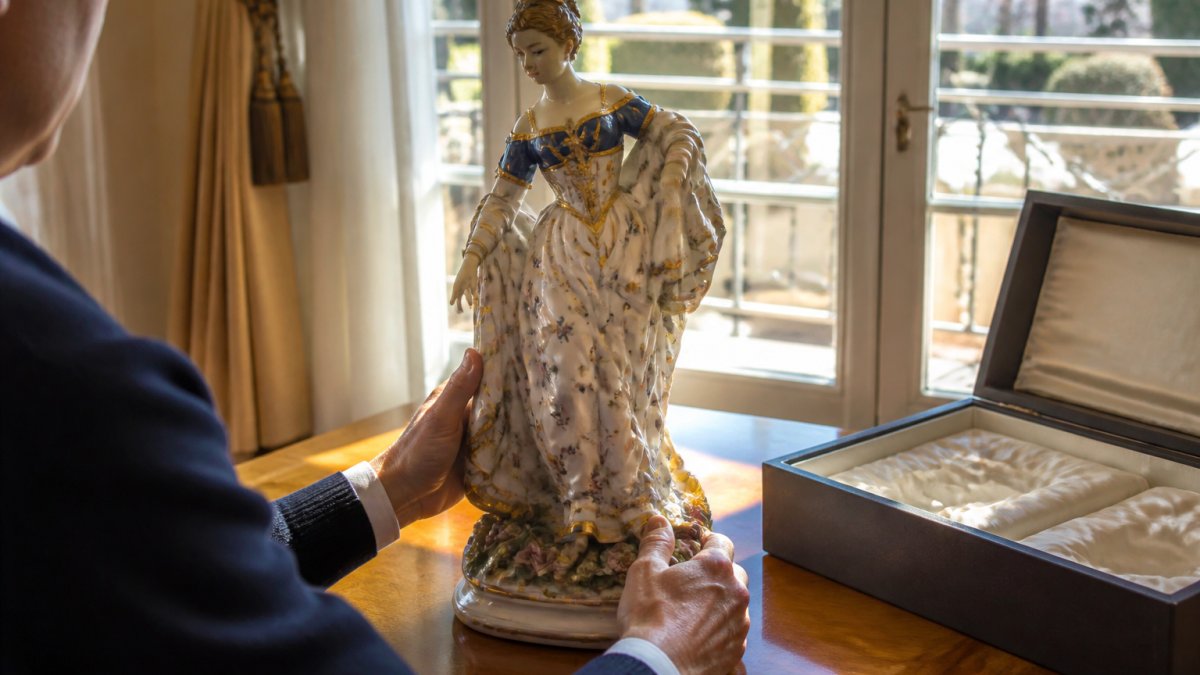
Quick Comparison: Ten Rare Lladro Sculptures and Their Asking Prices
| Sculpture | Item # | Edition | Height | Asking Price |
|---|---|---|---|---|
| Queen of the Nile | 01001918 | 100 | 29.5 in | $295,000 |
| 18th Century Coach | 01001485 | 500 | 17.75 in | $63,500 |
| Pursued Deer | 01001377 | 750 | 41.75 inches wide | $39,999 |
| Oriental Garden | 01001775 | 750 | 21 in | $32,500 |
| Guardian Lioness (Blue) | 01001990 | 188 | 27.25 in | $31,500 |
| Guardian Lion (Blue) | 01001991 | 188 | 27.25 in | $31,500 |
| Garden Party | 01001578 | 500 | 24.5 in | $7,950 |
| Maestro Matador (Green) | 01008730 | 250 | 18 in | $6,750 |
| Found Dulcinea | 01005341 | 750 | 15.25 in | $4,995 |
| Three Sisters | 01001492 | 3,000 | 13.75 in | $3,999 |
The Queen of the Nile and Other Monumental Masterpieces
The Queen of the Nile is the single most ambitious Lladró composition currently available, and at $295,000 it is priced accordingly. Sculpted by Juan Carlos Ferri Herrero and issued in 2006, it spans 63 inches wide and recreates an Egyptian royal vessel through a full procession of figures. Only 100 were made worldwide, and it retired in 2018. The last retail price was $200,000, which tells you where the secondary market has moved.

For collectors who want monumental scale without the seven-figure conversation, the 18th Century Coach (#01001485) delivers four horses, an ornate carriage, and a 44.5-inch span for $63,500. It was issued in 1985 as an Elite Limited Edition of 500 and carries a last retail of $58,605.
Lladró official heritage and High Porcelain archive
Lladró Figurine Value Guide: Edition Size, Sculptor and Last Retail
Most Lladró value guides stop at "edition size matters." That is true but useless without the mechanisms behind it. A Lladró figurine's value is set by four interacting variables: edition size, sculptor reputation, retirement status, and the gap between last retail and current asking price. Condition and completeness sit on top of those as multipliers or discounts.
Here is how each variable actually works.
Edition size sets the ceiling. A closed edition of 100 has a hard maximum supply. A closed edition of 3,000 has thirty times the supply chasing the same collector base. When demand is roughly equal, the smaller edition almost always trades higher per piece.
Sculptor reputation adds a premium. Pieces attributed to recognized Lladró sculptors, Juan Carlos Ferri Herrero, Salvador Furió, and the early workshop masters, carry a documented authorship that anonymous decorative pieces do not. The name on the piece is part of the provenance.
Retirement removes supply but does not create demand. A retired piece cannot be reordered from the factory, but if the edition was large and collector interest was thin, retirement changes little. The pieces that trade above last retail are the ones where the edition closed while demand stayed open.
The retail gap is the reality check. Compare last retail to current asking price. A piece asking $295,000 against a last retail of $200,000 is trading at a premium to retail. A piece asking $7,950 against a last retail of $7,250 is trading at roughly a 9.7% premium. Both are above retail, but the magnitude tells you how much of the price is scarcity and how much is speculation.
Apply the framework to two pieces in the table above:
- Found Dulcinea (#01005341), Don Quixote Collection, sculpted by Salvador Furió, edition of 750, retired 1990, asking $4,995.
- Three Sisters (#01001492), Elite edition of 3,000, asking $3,999.
Dulcinea is smaller in edition, older in retirement, and attributed to a named sculptor. Three Sisters is larger in edition and later in issue. The edition size and sculptor attribution are doing the work, not the physical size of the piece.

A common pattern among collectors is to treat "retired" as a synonym for "valuable." It is not. Retirement is a supply fact. Value is a demand fact. The two only align when the edition was small enough and the collector base large enough to keep the secondary market tight.
Lladró official heritage and High Porcelain archive
How to Identify Authentic Lladró Before You Buy
Authenticity comes down to four checks: the backstamp, the item number, the finish, and the documentation. Most listings show only the front of the sculpture, which is exactly the angle that hides a reproduction. Ask for the base before you ask for a price.
The backstamp. Lladró has used several backstamps since the 1950s, and the mark on the base should match the era the piece was issued. Early pieces carry the hand-painted blue mark; later pieces carry printed marks with the factory name and, on many editions, the edition number. A piece claiming a 1985 issue date with a backstamp introduced decades later is a mismatch.
The item number. Every genuine Lladró has a model number, usually stamped or applied on the base and often beginning with 0100. The number ties the piece to its edition, its sculptor, and its original configuration, including whether a base was issued with it. If a seller cannot produce the item number, treat the piece as unidentified until proven otherwise.
The finish. This is where counterfeits fail most often. Genuine High Porcelain has a depth of glaze and hand-painted detail that reproductions cannot match, particularly in the gold lustre work on pieces like the Queen of the Nile. Look for consistent brushwork, clean color transitions, and a glaze that reads as layered rather than flat. Under UV light, restoration and repainting often fluoresce differently from the original glaze.
The documentation. A Certificate of Authenticity should match the sculpture's item number, edition number, and issue year. Original boxes are item-specific on limited editions, so a box that does not match the piece is a warning sign, not a bonus.
LLADRO Guardian Lioness Blue 01001990 NEW IN BOX High Porcelain LE 188 →
A practical authentication sequence for any listing:
- Request photographs of the base, the backstamp, and the item number.
- Request a photograph of the Certificate of Authenticity, if one exists.
- Request a UV-light photograph of the piece to reveal repairs or repainting.
- Confirm the box, if offered, matches the item number.
- Compare the backstamp era to the claimed issue year.
Pursued Deer (#01001377) ships with its original box, base, and COA, which is the standard a serious purchase should meet. A piece missing any of those three is not disqualified, but it should be priced accordingly.
U.S. Customs and Border Protection guidance on importing works of art
Retired Lladró Figurines That Still Trade Above Retail
Retirement alone does not create value, but it removes supply. The pieces trading above their last retail are the ones where the edition closed while demand stayed open.
Oriental Garden (#01001775) retired in 2017 after 24 years in production. It was an Elite edition of 750, measures roughly 39 inches wide, and now asks $32,500. Garden Party (#01001578), retired in 1999, sits at $7,950 against a last retail of $7,250.

The clearest example is the Queen of the Nile: $200,000 at retail, $295,000 now.
Shipping Fragile Porcelain Sculptures Safely from Spain
Shipping fragile porcelain sculptures from Spain requires custom crating, full insurance, and a carrier experienced with oversized ceramics. A 63-inch composition cannot travel in a standard box.
Our approach is straightforward: fully insured transit on every piece. Several works, including Oriental Garden, ship free.
A few practical points:
Smithsonian Museum Conservation Institute guidance on caring for ceramic and porcelain objects
What to Check Before You Buy a Rare Lladró Sculpture
Before you buy, verify five things: backstamp, item number, edition size, condition, and documentation. Condition matters most on large compositions, where a single hairline crack can cut value sharply.
Ask these questions in writing:
- Is the original box included, and is it the correct box for this item number?
- Does the base come with the piece, where a base was originally issued?
- Is there a Certificate of Authenticity, and does it match the sculpture?
- Are there any chips, cracks, repairs, or restoration visible under UV light?
- What is the return policy if the piece arrives damaged?
Conclusion: Building a Collection That Holds Its Value
The hardest part of collecting rare Lladró is not finding pieces. It is finding them in the condition and completeness that protect your money. Editions close, bases go missing, and boxes get thrown away, and each loss chips at value.
At HIGH END COLLECTIBLES, we curate rare, retired, and limited edition Lladró masterpieces organized by rarity, artistic heritage, and collector demand, with museum-quality pieces sourced from Spain and private collections. Free shipping is available on select items, and every sculpture is professionally photographed, inspected, and fully insured.
Add to cart with confidence, or contact us directly for provenance and condition details on any piece.
Frequently Asked Questions
Which Lladró sculptures are the most valuable right now?
Scale, edition size and sculptor all drive value. The Queen of the Nile (#01001918) is a Limited Edition of 100 worldwide and carries a $295,000 asking price. Pursued Deer (#01001377) is an Elite Limited Edition of 750 from 1978, priced at $39,999. Guardian Lion and Guardian Lioness (LE 188, 2011) sit at $31,500 each. Pieces with the smallest worldwide editions and museum recognition tend to hold the strongest long-term value.
How can I tell whether a Lladró sculpture is authentic?
Start with the markings. Authentic pieces carry the Lladró backstamp and an item number that matches the sculpture, such as #01001485 for 18th Century Coach. Compare the item number against the sculptor, year issued and edition size. Ask the seller for clear photographs of the base, the stamp and any Certificate of Authenticity. A COA accompanies pieces like Pursued Deer and Three Sisters. If the stamp looks uneven or the item number does not match the model, walk away.
Do retired Lladró figurines increase in value over time?
Retirement removes new supply, which usually supports resale prices. Oriental Garden (#01001775) was issued in 1993 and retired in 2017, and new-in-box examples are now difficult to find. Garden Party (#01001578) retired in 1999 and Found Dulcinea (#01005341) retired in 1990. Both remain sought after by collectors completing specific series. Retirement alone does not guarantee appreciation, so pair it with a low edition size and strong collector demand.
How should fragile porcelain sculptures be shipped?
Every sculpture from High End Collectibles is professionally packed for safe transit and shipped fully insured. Pursued Deer ships directly from Spain with its original box and COA. Found Dulcinea and Three Sisters include their original bases.
What documentation should I expect with a rare Lladró purchase?
Ask for the item number, sculptor, year issued, edition size, finish and condition notes, plus photographs of the base and stamp. Pieces like Pursued Deer and Three Sisters include the original Certificate of Authenticity. High End Collectibles photographs and inspects each sculpture before it ships.

