

Investing in Museum Quality Porcelain Art: A Guide
Table of Contents
- Why Museum Quality Porcelain Art Attracts Serious Collectors
- How to Value Porcelain Art Before You Commit
- Valuable Porcelain Sculptures: What the Market Rewards
- Porcelain Art Provenance and Condition: The Two Documents That Protect You
- Where to Buy Museum Quality Porcelain Without Getting Burned
- Risks, Realistic Returns and What Most Buyers Get Wrong
- Conclusion: Building a Porcelain Collection That Holds Its Value
- Frequently Asked Questions
Last Updated: October 16, 2026
Why Museum Quality Porcelain Art Attracts Serious Collectors
Investing in museum quality porcelain art has moved from the curio cabinet to the portfolio. This guide from HIGH END COLLECTIBLES explains how seasoned collectors assess, acquire and hold pieces built to endure. Museum quality porcelain art is sculpture produced in tightly controlled editions, finished by hand, and documented well enough to stand up to institutional scrutiny.
Decorative porcelain is pleasant, replaceable and largely flat in value. Work made in editions small enough that supply cannot expand is where serious money now concentrates.
What Separates Museum Quality From Decorative Porcelain
Museum quality is defined less by beauty than by four verifiable facts: a named sculptor, a documented edition size, a recorded year of issue, and a complete original presentation.
A decorative piece may be lovely and still fail every one of those tests. Where the edition is open, the maker anonymous or the documentation missing, you are buying ornament rather than an asset.
How to Value Porcelain Art Before You Commit
Value in porcelain art is not a feeling. It is the sum of four measurable factors you can verify before money changes hands, plus a fifth step most buyers skip: independent authentication.
The Four Factors That Drive Valuation
- Edition size. A limited edition of 188 worldwide behaves very differently from one of 2,000. Scarcity sets the floor.
- Sculptor and series. Work by a named artist within a recognized collection carries a premium over unsigned production.
- Condition and completeness. Mint condition with original box, base and certificate is the benchmark. Anything less is a discount.
When you learn how to value porcelain art, you stop negotiating on aesthetics and start negotiating on evidence. Two identical sculptures can differ widely in price purely because one has its certificate and the other does not.
Authentication, Attribution and Provenance: A Step-by-Step Framework
Most competitors stop at "check the certificate." Serious collectors use this repeatable verification sequence before committing capital:
- Verify the maker's mark. High-end porcelain houses typically apply a backstamp, incised signature or underglaze mark. Compare it against the maker's published reference guides for the correct era, a mark that does not match the claimed issue year is a red flag.
- Confirm the edition number. Limited editions are individually numbered (for example, "No. 47 of 188"). The number should appear on the piece, the certificate and, where applicable, the original box label. Mismatched numbers are a common sign of a swapped or forged certificate.
- Cross-check the sculptor and year of issue. Reputable makers publish catalogues raisonnés or archived collection records. If the sculptor's name, title and year do not align there, treat the attribution as unverified.
- Trace ownership history. Ask for prior retail receipts, auction records or gallery invoices. A documented chain, even a short one, beats a verbal assurance of "bought from a good source."
- Commission an independent condition report if the value justifies it. For pieces in the four-figure range and above, a written condition report with dated photographs is standard practice.
Experienced buyers will walk away from a piece with a perfect surface if the paperwork chain has a single unexplained gap. The paperwork is not a formality, it is the asset.
Porcelain-Specific Market Evidence: What Actually Sells
General art-investment commentary rarely addresses porcelain directly. What the porcelain secondary market rewards, based on observable auction and dealer patterns, is narrower:
- Small editions in mint condition consistently outperform larger editions of comparable scale and subject.
- Museum exhibition history, a piece shown in a public institution, adds a documented layer of standing that is difficult to replicate.
- Monumental scale commands a premium because it reads as sculpture rather than ornament, and because large-format porcelain is harder to produce and ship intact.
Liquidity in this niche is real but slow. The strongest performers tend to be held for years, not flipped, the nature of a market where supply cannot expand because the editions are closed.
guidance on protecting and insuring fine art collections
Valuable Porcelain Sculptures: What the Market Rewards
The market rewards scale, drama and rarity, and pays most for pieces that combine all three. Monumental compositions with complex decoration consistently outperform small, quiet works.
A monumental limited edition of 188, such as the Guardian Lioness in blue sculpted by Francisco Polope, pairs an ancient guardian-lion motif with elaborate blue ornamentation and a 27.25-inch height.

Then there is historical weight. Pursued Deer, also known as Fearful Flight, was issued in 1978 as an Elite Limited Edition of 750 and is permanently exhibited in museum collections, including institutions in Brussels and Santo Domingo.
| Piece | Sculptor | Edition | Scale | What It Rewards |
|---|---|---|---|---|
| Guardian Lioness (Blue) | Francisco Polope | 188 | 27.25" high | Monumental scale, cultural motif |
| Tea in the Garden | José Puche | 2,000 | ~24" high | Floral complexity, up to 70 colors |
| The Birth of Venus | Antonio Ramos | 1,000 | 32" wide | Classical subject, movement |
| Pursued Deer | Salvador Furió | 750 | 41.75" wide | Museum exhibition history |
| 18th Century Coach | Francisco Catalá | 500 | 44.50" wide | Largest scale, smallest edition |
Porcelain Art Provenance and Condition: The Two Documents That Protect You
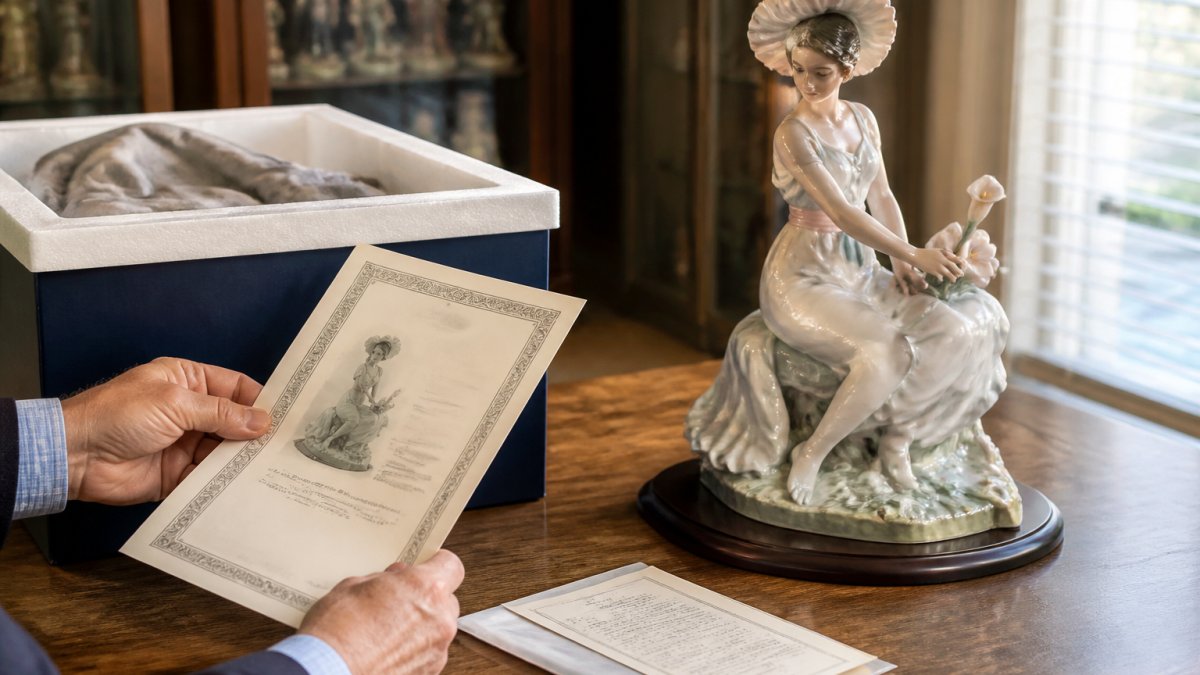
Porcelain art provenance and condition are the two things an insurer, a future buyer and an auction house will all ask about first. Get them right at purchase and you never have to reconstruct them later.

Provenance is the documented history of an object: who made it, when it was issued and how it reached you. Condition is its physical state, described honestly and specifically. Together they form the file that protects your investment:
- Original Certificate of Authenticity, issued by the maker
- Original box and display base
- Any prior retail or auction records
Condition, Restoration and Conservation: What Actually Affects Value
Most buying guides stop at "check for chips." In practice, condition in porcelain is graded on a spectrum, and the value impact is steep.
Common condition issues and their typical market effect:
- Hairline cracks or glaze crazing. Even a stable hairline can reduce value substantially, because it signals structural compromise and is difficult to reverse invisibly.
- Chips and losses. Missing petals, fingers or decorative elements are among the most expensive defects to restore convincingly, and even a good restoration is disclosed at resale.
- Restoration. A professionally restored piece can look perfect and still be worth materially less than an unrestored example. The general rule in the secondary market: restoration is disclosed, and disclosure carries a discount.
Conservation and storage practices that protect value:
LLADRO Guardian Lioness Blue 01001990 NEW IN BOX High Porcelain LE 188 →
- Display away from direct sunlight and heat sources; UV damage is cumulative and permanent.
- Use stable, padded mounts and bases, original bases are part of the asset, not an accessory.
- Handle with clean cotton gloves; skin oils and salts can etch glaze over time.
Conservation costs. Professional porcelain conservation is specialized work, and costs scale with the piece's complexity and the damage's extent. For a monumental or highly decorated sculpture, conservation can run into meaningful four-figure sums, which is why a piece with existing damage should be priced well below a mint example of the same edition.
Provenance in Practice: What a Strong File Looks Like
A strong provenance file is not just the certificate but a small dossier:
- The maker's Certificate of Authenticity, matching the piece's edition number
- The original box and display base
- Any prior retail receipts, gallery invoices or auction records
When you buy from a specialist, ask to see this file before you see the price. A seller who produces it quickly has done the work; one who cannot is asking you to take on their risk.
Where to Buy Museum Quality Porcelain Without Getting Burned
Where to buy museum quality porcelain comes down to one test: can the seller show you the documentation before you pay? Reputable specialists photograph the certificate, base and box, and describe condition plainly.
The secondary market is where rare pieces live, because the finest editions sold out at issue and rarely resurface. At HIGH END COLLECTIBLES, our inventory is organized by rarity, artistic heritage and collector demand, so you can see why a given piece sits where it does.
That framing matters more than any single listing. A sculpture offered with its full presentation, such as The Birth of Venus, an Elite Limited Edition of 1,000 sculpted by Antonio Ramos, is a different proposition from the same work stripped of its paperwork. The 18th Century Coach, an Elite Limited Edition of 500 spanning 44.50 inches, is the kind of piece where condition questions should be answered before purchase, not after.

guidance on cultural property and lawful art acquisition
Risks, Realistic Returns and What Most Buyers Get Wrong
The biggest risk in porcelain is not market movement but buying an incomplete or misdescribed piece at a complete price.
Most buyers get three things wrong: they chase decoration instead of editions, accept verbal assurances about condition instead of a written report, and treat an asking price as a valuation, when valuation depends on edition size, sculptor, condition and provenance together.
Returns are realistic but not guaranteed. The strongest performers tend to be the smallest editions in mint, complete condition, held for years rather than flipped.
Conclusion: Building a Porcelain Collection That Holds Its Value
The challenge is not finding beautiful porcelain but pieces whose rarity, documentation and condition can survive scrutiny years from now.
That is the standard we build to at HIGH END COLLECTIBLES. Our collection of rare, retired and limited edition Lladró masterpieces is organized by rarity and artistic heritage, every piece selected for craftsmanship and completeness, with free shipping on select items.
Frequently Asked Questions
Is investing in museum quality porcelain art a good investment?
It can be, but only for the right pieces. Limited editions with low production numbers, documented provenance and mint condition hold value best. Lladró's Elite Limited Edition works, such as Pursued Deer at 750 pieces worldwide, are permanently exhibited in museum collections in Brussels and Santo Domingo, which supports long-term demand. Treat porcelain art as a long-hold asset, not a quick flip, and buy only what you can store and insure properly.
How can you tell whether a porcelain sculpture is valuable?
Check four things: edition size, sculptor, condition and completeness. A smaller edition raises scarcity. Named sculptors such as Salvador Furió, José Puche and Francisco Polope carry collector demand. Mint condition with no chips, cracks or restoration matters most. Finally, the original box, display base and Certificate of Authenticity add real value. A piece missing its COA or base typically sells for less than a complete example of the same edition.
Does limited-edition porcelain increase in value?
Not automatically. Scarcity only drives value when collector demand exists. Lladró's High Porcelain editions, such as Guardian Lioness at 188 pieces worldwide or the 18th Century Coach at 500, combine low numbers with recognised artistry, which supports secondary-market prices. Editions of several thousand pieces appreciate more slowly. Before buying, confirm the edition size and check whether the series has an active collector base.
What should collectors check before buying porcelain art?
Ask for the item number, sculptor name, year issued, edition size and a condition report. Request photos of the base, any maker's marks and the Certificate of Authenticity. Confirm whether the original box and display base are included. For high-value pieces, ask how the sculpture will be packed and shipped, and whether the seller offers a return or dispute process if the piece arrives in a condition other than described.
How important are provenance and condition when valuing porcelain?
They are the two biggest swing factors after rarity. Provenance covers the documented history of ownership, including the COA, original packaging and any exhibition record. Condition covers the physical state, including chips, repairs or repainting. A mint example with full documentation can command a substantial premium over an identical edition with a repaired chip or a missing certificate, so always request both before agreeing a price.
Where can you buy museum-quality porcelain art?
Specialist dealers that curate by rarity and artistic heritage are the safest route. HIGH END COLLECTIBLES, for example, organises inventory by rarity, artistic heritage and collector demand, and offers pieces such as The Birth of Venus, an Elite Limited Edition of 1,000, complete with the original box. Buying through a specialist reduces the risk of reproductions and gives you documentation for insurance.
How should porcelain sculptures be stored and insured?
Keep sculptures out of direct sunlight and away from radiators, because porcelain and glazes can suffer from rapid temperature swings. Display them on a stable base, ideally inside a locked cabinet if you have children or pets. For insurance, photograph each piece from several angles, keep the COA, original box and any valuation report together, and review the sum insured every few years as market values shift.


