

Lladró Porcelain Sculpture Collection Catalog: A Collector's Guide
Last Updated: November 20, 2026
Quick Summary
A Lladró porcelain sculpture collection catalog is a searchable reference that organizes each piece by name, collection, era, material, and design, pairing item numbers with titles, sculptors, and issue and retirement dates. Use it to identify pieces, verify authenticity, and build valuations from documented records rather than a single price list.
- A complete catalog entry pairs the item number with Spanish and English titles, sculptor, issue year, and retirement year.
- Retirement alone does not establish rarity; edition size and production window do the real work.
- The Guardian Lioness (Blue), item 01001990, was sculpted by Francisco Polope and limited to 188 pieces worldwide.
- Verify authenticity at the base: maker's mark, incised number, glaze consistency, sculptural detail, and documentation.
- Record item number, title, sculptor, dates, edition size, condition, and purchase source for every piece you own.
Table of Contents
- Why a Lladró Porcelain Sculpture Collection Catalog Matters
- Reading the Catalog: What Each Entry Tells You
- Navigating Lladró Collection Categories
- Retired vs. Limited Edition: What the Catalog Distinction Means
- Identifying a Lladró Sculpture and Verifying Authenticity
- Retired-Piece Pricing: How Valuation Factors Work
- Building and Organizing Your Collection by Theme
- Explore Rare Lladró Masterpieces at High End Collectibles
- Frequently Asked Questions
Why a Lladró Porcelain Sculpture Collection Catalog Matters
A Lladró porcelain sculpture collection catalog is the single most useful reference a collector can own, because it converts a shelf of beautiful objects into a documented, searchable body of work.

The catalog matters most when you are hunting a specific retired piece. A name remembered from an auction listing, a number glimpsed on the underside of a base, a sculptor whose work you admire: each becomes a search key once you understand how Lladró organizes its output.
Reading the Catalog: What Each Entry Tells You
A well-built catalog is a searchable index, not a price list or a picture book, and its value depends on how it is organized. The most useful approach lets you sort the same body of work along several independent axes at once.
The Five Axes of a Searchable Catalog
A genuinely comprehensive catalog organizes each sculpture by name, collection, era, material, and design. In practice, that means every entry should be retrievable through at least these five keys:
- Name. The Spanish title and the English title, because auction listings and secondary-market sellers use both inconsistently.
- Collection. High Porcelain, limited editions, classic figurative series, thematic groups (dancers and performing arts, Asian and Oriental artistry, religious and contemplative works, licensed themes). Collection membership tells you the house's intent for the piece.
- Era. Issue year and retirement year, which together define the production window.
- Material and finish. Glazed porcelain versus matte or gres finishes, and any secondary material such as wood or metal in the base or mount.
- Design. Subject family, sculptor, and scale. Sculptor credit is where collector interest concentrates: Francisco Polope, Salvador Furió, and their peers each leave a recognizable signature in the modeling.
Item Numbers, Sculptor Names, and Issue Dates
The item number is the spine of the record. Lladró reference numbers are alphanumeric item numbers, and a complete catalog entry pairs that number with the Spanish title, the English title, the sculptor, the year issued, and, where applicable, the year retired.
Issue and retirement dates carry equal weight. A defined production window is the first filter in any serious search, and it is the field most often missing from casual retailer listings.
Product Images and Visual Galleries
Photography does more work in porcelain collecting than in almost any other field. Glaze depth, the fall of light across a face, the crispness of a ruffle or a mane: these details separate a strong example from an average one.
Catalog photography is often shot under controlled studio light, and glazed porcelain can read differently in a living room. Ask for natural-light images of any piece you are seriously considering.
Catalog Completeness and Sourcing
No single catalog is complete, and the honest ones say so. A dependable catalog states its coverage, its sourcing, and the date it was last updated. When you build your own working catalog, record the source and date for every entry.
Navigating Lladró Collection Categories
Lladró's output divides into recognizable families, and knowing which family a piece belongs to tells you most of what you need about scarcity and intent. The major divisions are High Porcelain, limited editions, and the classic and thematic series.
High Porcelain and Limited Editions
High Porcelain represents the top of the house: monumental scale, elaborate ornamentation, and small edition sizes. Collectors who want to see a High Porcelain Elite Limited Edition in detail can explore the 18th Century Coach as a reference point for how these pieces are documented.

Limited editions sit just below, often with edition sizes in the hundreds or low thousands. The distinction between the two is not marketing language; it is a statement about how many examples will ever exist.
Classic, Contemporary, and Thematic Series
The classic line carries the pastoral and figurative subjects that built Lladró's reputation. Contemporary work pushes toward abstraction and stylized form. Thematic series group sculptures around a subject: dancers and performing arts, Asian and Oriental artistry, religious and contemplative works, and licensed themes. Browsing by theme is often the fastest route for a collector who knows the subject they want but not the title. Our Elite Limited Editions collection is organized with exactly that kind of browsing in mind.
Retired vs. Limited Edition: What the Catalog Distinction Means
Retirement and limited edition are two different facts, and conflating them is the most common error we see. A retired piece is simply one that Lladró has stopped producing. A limited edition is one that was capped at a stated number from the outset.
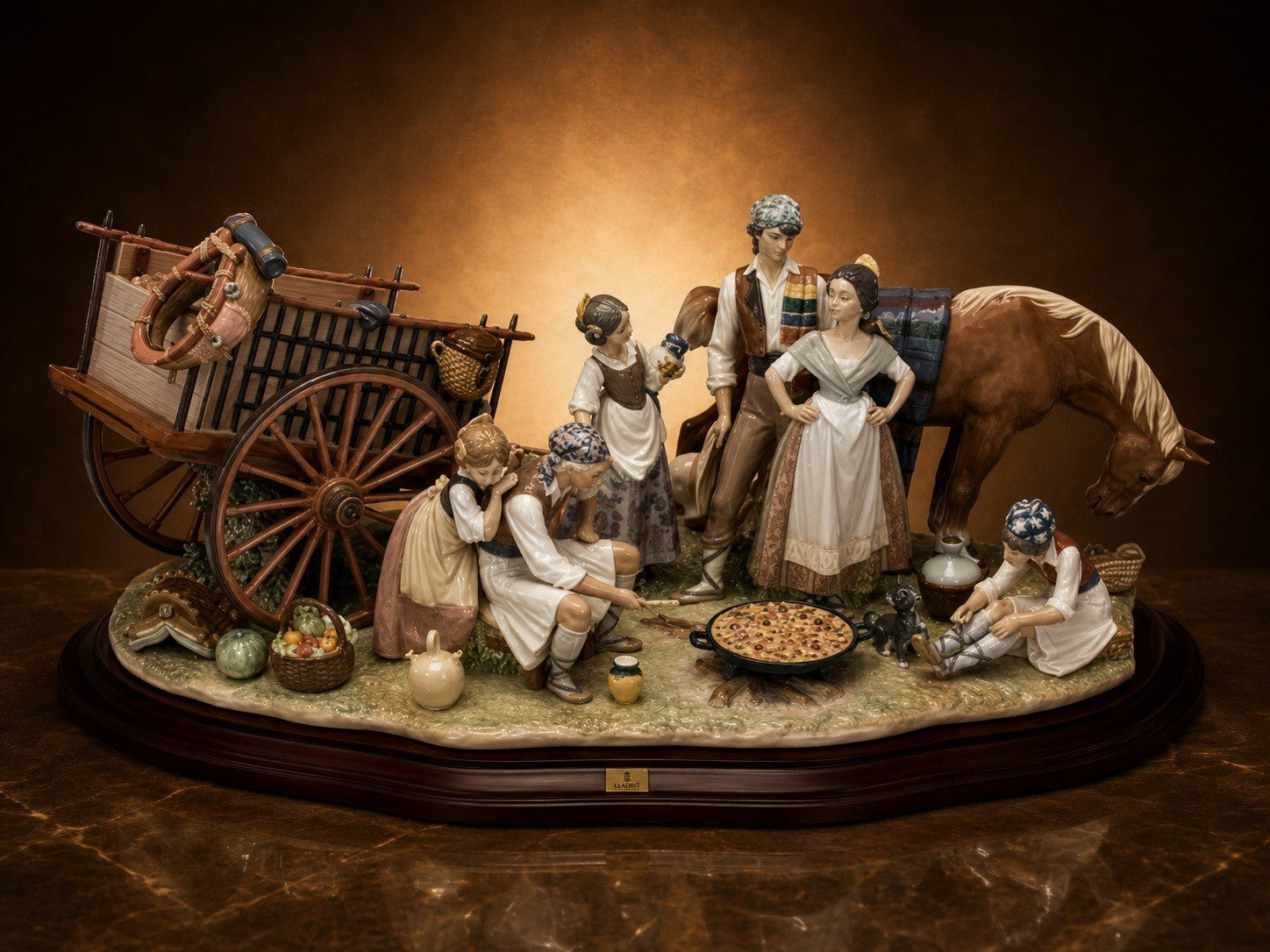
Why does the distinction matter? Because retirement alone does not establish rarity. The Paella Valenciano, item 1762, offers a second useful reference because it is both retired and a limited edition with a stated edition size, which you can view in the catalog listing.
| Attribute | Retired Piece | Limited Edition |
|---|---|---|
| Definition | Production has ended | Capped at a stated number |
| Rarity driver | Demand and surviving examples | Edition size from day one |
| Catalog marker | Retirement year | Edition size plus issue year |
| Collector impact | Variable | Predictable ceiling |
Identifying a Lladró Sculpture and Verifying Authenticity
Authenticity verification starts at the base. Lladró marks its work with a maker's mark and, on many pieces, an incised or stamped reference number that should correspond to the catalog entry.
Documentation carries the rest of the weight. For a working example of how a documented listing looks, see this Scheherazade limited edition with COA, which shows the kind of paperwork a careful buyer should expect.

Markers of Authenticity and Craftsmanship
The table below summarizes what we check, and what each marker tells you.
| Marker | What to Look For | Why It Matters |
|---|---|---|
| Maker's mark | Clean, consistent stamp on the base | Confirms house origin |
| Incised number | Matches the catalog reference | Ties piece to its record |
| Glaze consistency | Even coverage, no pooling at edges | Signals quality control |
| Sculptural detail | Crisp fingers, faces, fabric folds | Hard to reproduce in copies |
| Documentation | COA, original box, provenance | Supports insurance and resale |
A common mistake is treating a single marker as proof. Genuine Lladró work shows several of these at once, and the catalog entry is what lets you confirm the number, the title, and the sculptor line up.
Retired-Piece Pricing: How Valuation Factors Work
Pricing a retired Lladró sculpture is a matter of weighing factors, not consulting a single number. The catalog gives you the framework; the market fills in the rest.
A Four-Step Valuation Method
- Establish the record. Confirm the item number, title, sculptor, issue year, retirement year, and edition size against the catalog. A valuation built on a misidentified piece is worthless.
- Gather comparables. Collect recent sales of the same item number in comparable condition. A different colorway or a different edition is a different comparable.
- Adjust for condition and completeness. Original box, base, certificate, and any included accessories matter. A chip, a lost accessory, or a repaired area changes the picture entirely.
- Weight demand. Some subjects draw sustained collector attention; others are quieter. Demand explains why two pieces with identical edition sizes can behave very differently on the secondary market.
The Factors, in Order of Weight
- Edition size. Smaller editions generally command stronger secondary interest, though a large edition of a beloved subject can still perform well. Edition size sets a ceiling; it does not set a floor.
- Condition. Original box, base, and complete sets matter. Condition is the factor most within a seller's control.
- Sculptor. Work by a recognized hand attracts dedicated buyers who follow a body of work rather than a single subject.
- Subject demand. Certain themes draw sustained collector attention; others are quieter. This is the least predictable factor and the one that rewards watching the market over time.
- Documentation. A certificate of authenticity and clear provenance support both insurance valuation and resale.
What Retirement Does and Does Not Tell You
Retirement alone does not establish rarity. Many retired pieces were produced in large open editions and remain readily available. The Auspicious Dragon (Green), item 01008563, illustrates the point: issued in 2012, retired in 2021, and capped at 1,500 pieces worldwide.
| Attribute | Retired Piece | Limited Edition |
|---|---|---|
| Definition | Production has ended | Capped at a stated number |
| Rarity driver | Demand and surviving examples | Edition size from day one |
| Catalog marker | Retirement year | Edition size plus issue year |
| Collector impact | Variable | Predictable ceiling |
We do not publish a price guide, and we would caution against treating any single source as definitive. Valuation is a judgment built from comparables, condition, and the piece's own record.
Building and Organizing Your Collection by Theme
The collectors who enjoy their collections most are the ones who organize them.
Start with one theme and let it deepen. Those planning a licensed theme can browse the Disney Collection to see how an established series is organized.
Keep a simple record for every piece: item number, title, sculptor, issue year, retirement year, edition size, condition notes, and where you bought it.
Explore Rare Lladró Masterpieces at High End Collectibles
Building a collection around documented, verified pieces takes patience and a reliable source. High End Collectibles curates rare, retired, and limited-edition Lladró masterpieces, organized by rarity, artistic heritage, and collector demand.
If you are ready to add a documented masterpiece to your collection, our team can help you understand which pieces suit your theme and your goals.
A collection is built one verified piece at a time, and the catalog is what keeps that record honest.
Frequently Asked Questions
Where can I find a catalog of Lladró porcelain sculptures?
A dedicated retailer catalog is the most practical starting point for collectors. High End Collectibles organizes its inventory of rare, retired, and limited edition Lladró masterpieces by rarity, artistic heritage, and collector demand, with item numbers, sculptor names, and issue dates listed where verified. Official Lladró reference materials and collector-society archives are useful supplements for pieces no longer in production.
How do I identify a Lladró figurine from a catalog?
Start with the item number, usually found on the underside of the base alongside the maker's mark. Match that number against the catalog entry, then confirm the sculptor name, issue year, and finish. A catalog entry for a piece like Guardian Lioness (Blue), item 01001990, lists the sculptor, year issued, edition size, and dimensions, giving you several points to cross-check against the physical piece.
How can I check whether a Lladró sculpture is a limited edition?
The catalog entry should state the edition size directly, for example a Limited Edition of 188 pieces worldwide or 750 pieces worldwide. Limited editions are numbered and typically accompanied by documentation. Retirement alone does not make a piece a limited edition, so confirm both attributes separately before you treat a sculpture as rare.
What information does a Lladró sculpture catalog include?
A well-built entry covers the item number, Spanish name, sculptor, year issued, retirement year where applicable, finish, edition size, dimensions, and condition. High End Collectibles also notes whether the original box and base are included. Collectors should treat any listing missing these basics with caution and ask for documentation before committing.
How can I find retired Lladró figurines in a catalog?
Filter for pieces marked as retired or discontinued, then read the retirement year to understand how long production has been closed. High End Collectibles lists retired pieces such as Wisdom of Buddha, item 01001927, with issue and retirement dates. Availability is limited, so inquire promptly when a piece you need appears.
How do I organize a Lladró collection by theme or collection?
Group pieces by the series or theme they belong to, such as Asian and Spiritual Creatures works, dancers and performing arts, or High Porcelain masterpieces. Keep a simple record of item numbers, acquisition dates, and condition notes for insurance purposes. Organizing by theme also makes gaps in a series easier to spot when you review new catalog arrivals.


