

How to Collect Lladró Cinderella Sculptures
Last Updated: November 21, 2026
Quick Summary
To collect a Lladró Cinderella sculpture, focus on the three-piece series: The Glass Slipper (01005957, retired 2001), Cinderella's Arrival (01001785), and At the Stroke of Twelve (01001493), each by a different sculptor. Authenticate each piece by reading its backstamp, item number, and modeling together, then value it through normalized comparable sold prices rather than asking prices.
- The Glass Slipper was sculpted by José Puche and retired in 2001 at 11 inches high.
- Cinderella's Arrival, by Francisco Polope, is limited to 1,500 worldwide and measures 45.25 inches wide.
- At the Stroke of Twelve, sculpted by José Roig, was issued in 1986 and retired in 1992.
- Authentication accumulates signals: backstamp, item number, glaze, modeling, and provenance checked together.
- Normalize each comparable sale for condition, completeness, venue, and date before setting a valuation.
Table of Contents
- Why Lladró's Cinderella Sculpture Series Matters to Collectors
- The Cinderella Series: Three Sculptures, Three Moments
- Sculptors, Design Attribution, and What the Modeling Reveals
- How to Authenticate a Lladró Cinderella Sculpture
- Condition Grading and Its Effect on Resale Value
- Edition Status, Documentation, and Provenance
- How to Research Comparable Sales and Market Price
- Handling, Display, Transport, and Insurance
- Frequently Asked Questions
Why Lladró's Cinderella Sculpture Series Matters to Collectors
The Lladró Cinderella sculpture series turns a familiar fairy tale into glazed porcelain of real emotional weight.
That focus is rare. Most fairy-tale porcelain settles for a pretty pose. Lladró's Cinderella sculpture instead gives us the slipper, the arrival, and the flight at midnight as separate works, each with its own sculptor and production history.
Collectors return to these pieces because they reward close looking: the modeling of a gown, the tilt of a head, the way a hand reaches.
The Cinderella Series: Three Sculptures, Three Moments
The series works as three distinct scenes, each capturing a different beat of the story and each modeled by a different hand.
A quick comparison helps frame the three works:
| Sculpture | Item Number | Sculptor | Status | Scale |
|---|---|---|---|---|
| The Glass Slipper (Cenicienta) | 01005957 | José Puche | Retired 2001 | 11" high, 7" wide |
| Cinderella's Arrival | 01001785 | Francisco Polope | Limited Edition, 1,500 worldwide | 17.75" high, 45.25" wide |
| At the Stroke of Twelve | 01001493 | José Roig | Elite Limited Edition, 1,500 worldwide, retired 1992 | 11" high, 26.75" wide |
Item Number
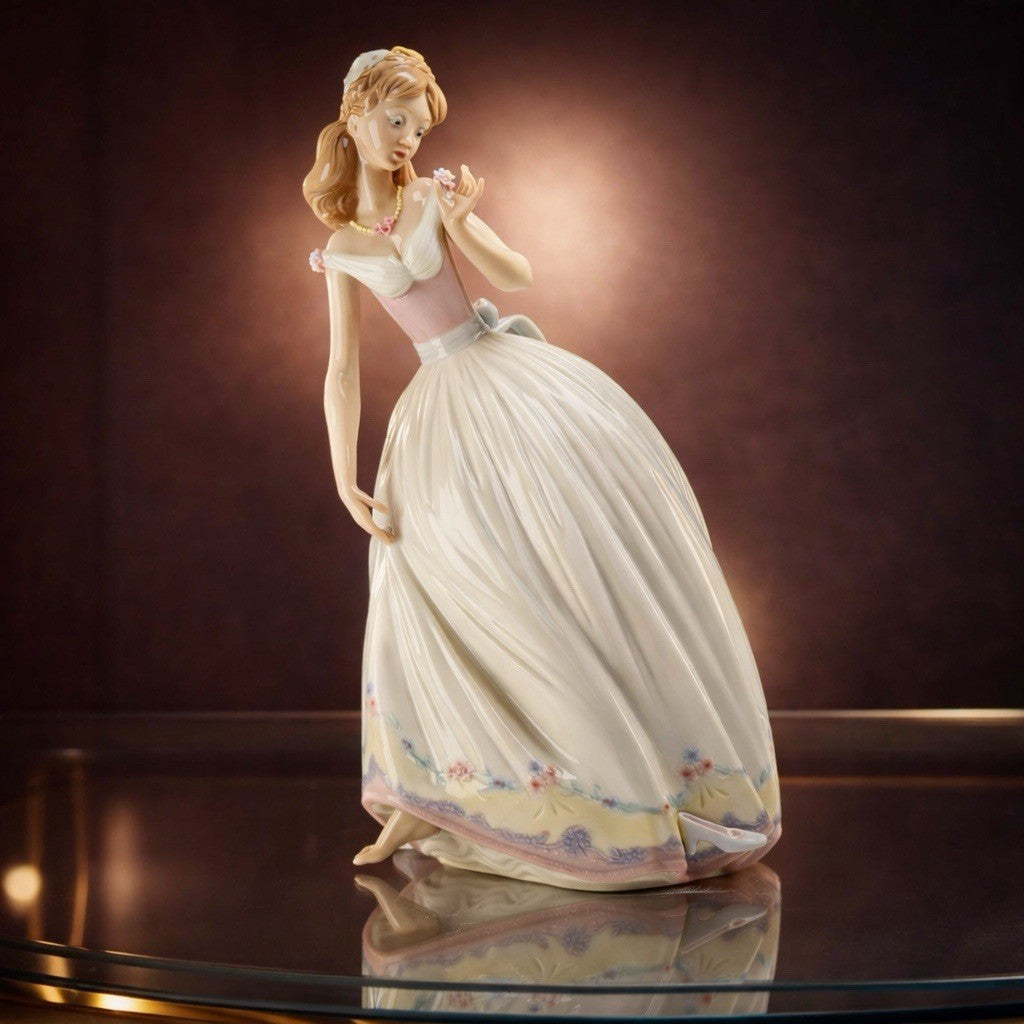
The Glass Slipper (Cenicienta), #01005957
The Glass Slipper is the most intimate of the three. Sculpted by José Puche, it shows Cinderella in an elegant white gown with delicate pink accents, golden detailing, and graceful embellishments. The flowing dress is the heart of the piece.
Retired in 2001, this figurine stands 11 inches high and 7 inches wide. View The Glass Slipper (Cenicienta) to see the piece and its condition.
Cinderella's Arrival, #01001785
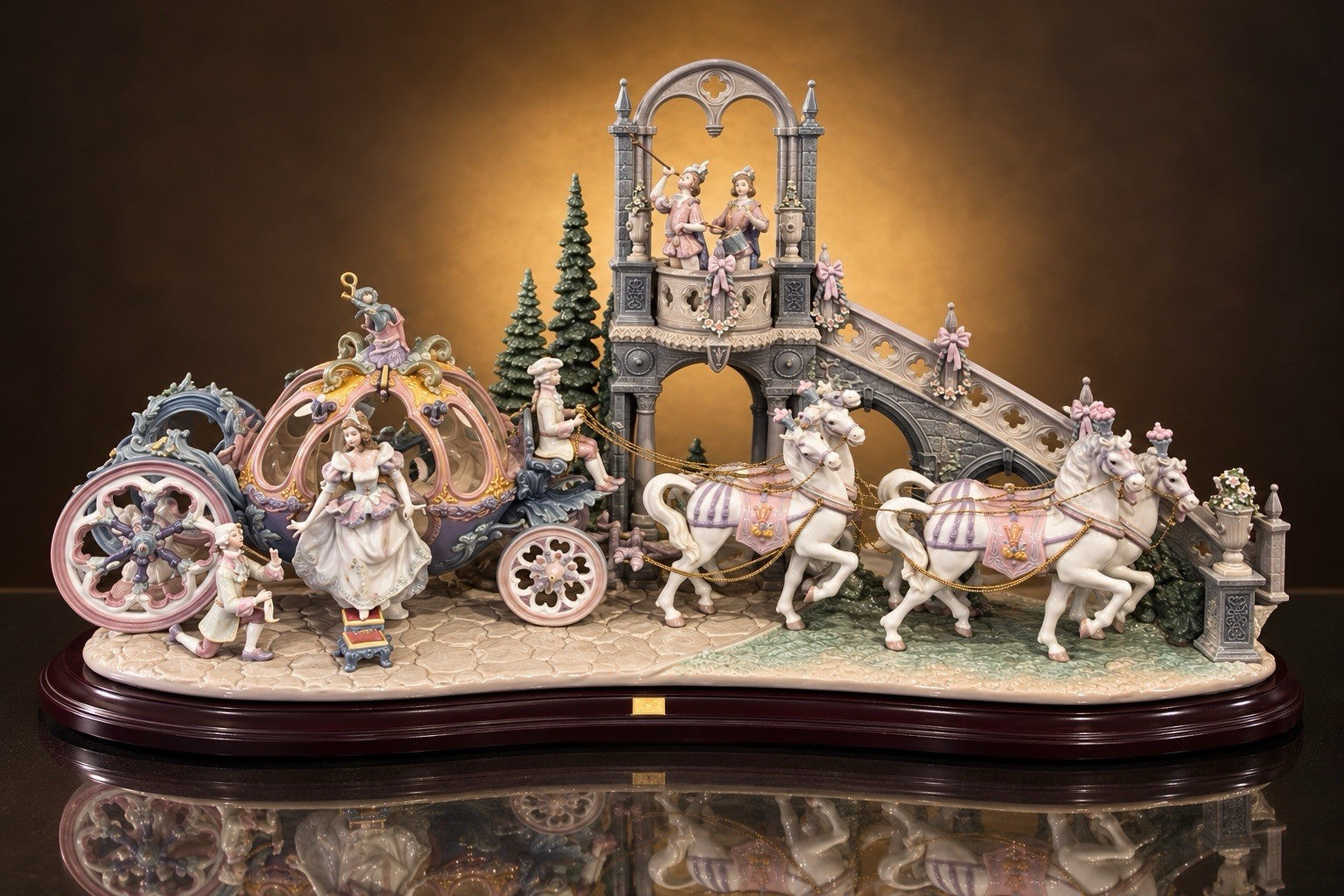
Cinderella's Arrival is the monumental work of the series. Modeled by Francisco Polope and issued in 2005, it captures Cinderella stepping from her carriage, drawn by four sculpted horses, framed by a castle arch.
This High Porcelain piece from the Elite Collection is limited to 1,500 worldwide. At 17.75 inches high and 45.25 inches wide, with its base included, it is a centerpiece built for a serious display. See Cinderella's Arrival and its base as offered by High End Collectibles.
At the Stroke of Twelve, #01001493
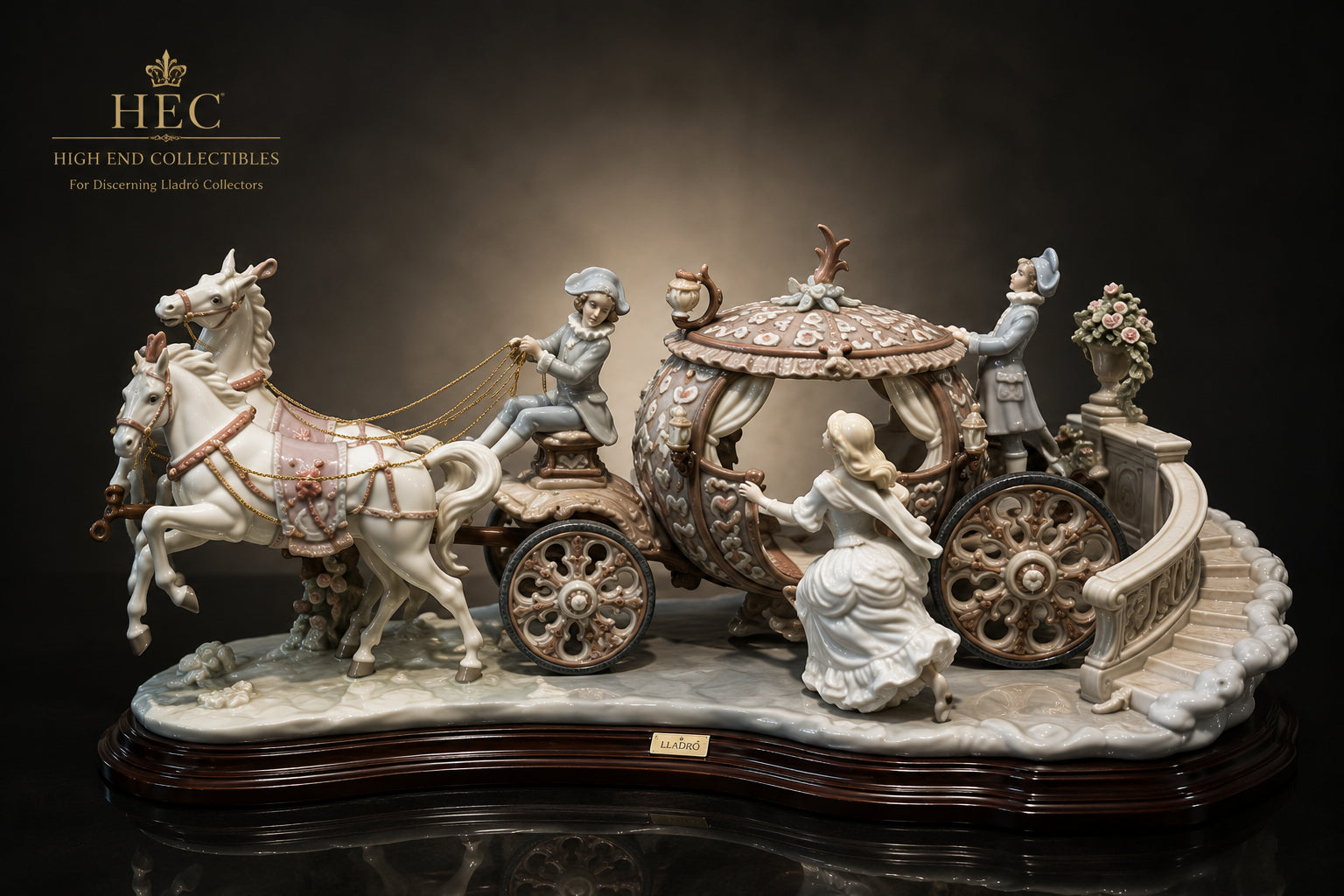
At the Stroke of Twelve shows the flight itself, as midnight strikes. Sculpted by José Roig, this Elite Limited Edition was issued in 1986, retired in 1992, and restricted to 1,500 pieces.
It measures 11 inches high and 26.75 inches wide, and it includes its original base, presentation box, and insured shipping. Explore At the Stroke of Twelve to confirm what is available.
Sculptors, Design Attribution, and What the Modeling Reveals
Attribution matters in Lladró collecting because each sculptor leaves a recognizable signature in the clay. The Cinderella series is a useful study in three different hands working the same story.
José Puche's Glass Slipper emphasizes the gown and the quiet gesture. Francisco Polope's Cinderella's Arrival is built around horses, a carriage, and a crowd of figures. José Roig's At the Stroke of Twelve is built around movement.
How to Authenticate a Lladró Cinderella Sculpture
Authenticity is the first question serious collectors ask. A Lladró Cinderella sculpture is identified by its marks, its finish, and the quality of its modeling, checked together rather than in isolation. No single signal proves a piece genuine; read several as a group and notice when one contradicts the others.
Start with a practical checklist:
- Look for the Lladró backstamp on the underside
- Confirm the item number matches the piece you are examining
- Check the glaze for an even, deep sheen with no cloudy patches
- Inspect the hands, faces, and drapery for crisp modeling
- Look for a sculptor's mark where the piece carries one
- Ask for provenance and original packaging where available
For a deeper walkthrough, our guide on how to spot fake Lladró breaks the process into clear steps.
Reading the Mark When the Label Is Missing
When the paper label is gone, rely on the marks under the base instead.
Look for the Lladró mark, the item number, and any sculptor's mark. If the marks look inconsistent with the age of the piece, slow down and ask questions.
Matching the Mark to the Production Era
The single most useful authentication skill is reading a mark against the years it belongs to.
A few era markers are worth memorizing:
Photographing the base of a piece, taken straight on and well lit, makes it easier to compare the item number and marks against reference images later.
Weighing the Signals Together
Authentication is a process of accumulation, not a single test. A genuine piece tends to satisfy every check at once, while a reproduction usually fails more than one of them.
When you find a contradiction, treat it as a reason to pause rather than walk away immediately.
For pieces you intend to insure or resell, keep your own record of the marks, the item number, and the condition at purchase.
Condition Grading and Its Effect on Resale Value
Condition is an important factor in valuing these pieces. Two examples of the same sculpture can differ in price based on condition.
A simple grading scale helps:
- Mint: no chips, cracks, crazing, or restoration; original finish intact
- Excellent: minor wear only, no structural issues
- Good: small chips or light crazing, fully disclosed
- Fair: visible damage or restoration, priced accordingly
The most damaging issues are chips on protruding details like fingers, flowers, or horse legs, and any sign of restoration.
A single chip can affect a large composition. Ask for detailed photographs of every figure before you commit.
Edition Status, Documentation, and Provenance
Edition status and documentation are what separate a decorative object from a collectible with a paper trail. They also protect you if you ever need to sell or insure the piece.
The Glass Slipper was retired in 2001. Cinderella's Arrival and At the Stroke of Twelve are limited editions of 1,500 worldwide.
Keep and request:
- The original presentation box and base
- Any certificate of authenticity
- The edition number where the piece carries one
- Receipts, prior sale records, and any correspondence
Provenance is the story of where a piece has been. A clean chain of ownership, even a short one, adds confidence.
How to Research Comparable Sales and Market Price
Market price for a Lladró Cinderella sculpture is best understood through comparable sales, not asking prices. Asking prices tell you what a seller hopes for; sold prices tell you what buyers actually paid.
Build your research around these steps:
- Collect recent sold listings for the exact item number
- Note condition, completeness, and whether the base and box were included
- Discard outliers caused by damage or missing parts
- Compare like with like: a mint piece with box is not the same as a loose example
- Track a few sales over time rather than relying on one result
Normalizing Sales Before You Compare
The mistake most collectors make is averaging sold prices without adjusting for the variables that move them. Two sales of the same item number can differ substantially for reasons unrelated to the market. Before drawing any conclusion, normalize each sale across four dimensions:
- Condition: a mint example and one with a disclosed chip are not comparable. Separate them and treat the damaged sale as a floor, not a benchmark.
- Completeness: the presence of the original base, presentation box, and certificate changes what a buyer is actually purchasing. A loose piece and a complete one belong in different comparison sets.
- Venue: auction houses, specialist dealers, and general marketplaces attract different buyers and produce different results.
- Date: a sale from several years ago reflects a different market. Weight recent sales more heavily and note the date of every result you keep.
A practical method is to build a simple table with one row per sale and columns for item number, date, venue, condition grade, completeness, and final price. Once the rows are side by side, patterns emerge that a single listing cannot show.
Reading the Pattern, Not the Number
What you are looking for is not a single figure but a range and a trend. A healthy comparison set produces a cluster of similar results with a few outliers at either end.
Ask of every outlier: what explains it? A damaged piece selling low is informative about the cost of condition.
Watch out: a single strong sold price is often circulated online as if it were the market, when it may reflect an unusual buyer, an unusually complete example, or a venue effect that will not repeat.
Turning Research into a Defensible Valuation
When you have a normalized set of recent sales, you can state a valuation with confidence rather than hope. Describe the piece in the same terms you used to normalize the sales, condition grade, completeness, venue context, and place it against the matching cluster.
For a valuation you can hand to an insurer, our guide on valuing retired porcelain for insurance explains what documentation appraisers and insurers expect.
Handling, Display, Transport, and Insurance
Porcelain rewards careful handling, and the large compositions in this series demand it.
When displaying, keep pieces out of direct sunlight and away from heat sources.
When moving a piece, wear cotton gloves and lift from the base with both hands.
Insurance deserves its own attention. Photograph each piece from several angles, keep receipts and any certificates together, and update your valuation periodically.
Collecting the Lladró Cinderella series rewards patience and preparation. At High End Collectibles, we curate Rare & Retired Lladró Masterpieces and Limited Collections organized by rarity and artistic heritage.
Frequently Asked Questions
How can I determine the value of my Lladró Cinderella figurine?
Start with the item number, since each Cinderella piece is valued on its own record rather than on the character. The Glass Slipper is #01005957, Cinderella's Arrival is #01001785, and At the Stroke of Twelve is #01001493. Then compare recent sold prices for that exact number, note whether the original base, box, and certificate are present, and grade condition honestly. A complete, undamaged piece with documentation will sit at the top of the range for its model; a repaired or incomplete example will not.
How do I identify a Lladró Cinderella sculpture if its label is missing?
Work from the sculpture itself. Compare the composition, height, and width against the catalogued specifications for each model, then examine the underside for an incised or stamped Lladró mark rather than the paper label. The Glass Slipper stands 11 inches high and 7 inches wide, while At the Stroke of Twelve is 11 inches high and 26.75 inches wide, so scale alone separates those two. Cinderella's Arrival, at 17.75 inches high and 45.25 inches wide and issued with a base, is unmistakable once you know its dimensions.
Does a limited-edition Lladró Cinderella sculpture have a higher value?
Edition size shapes scarcity, but it does not set value by itself. At the Stroke of Twelve was an Elite Limited Edition of 1,500 pieces worldwide, issued in 1986 and retired in 1992. Cinderella's Arrival was also limited to 1,500, issued in 2005 as part of the High Porcelain line. The Glass Slipper was a retired open edition, retired in 2001. Within any edition, condition, completeness, and documented provenance still decide where an individual piece lands.
What should I compare when researching Lladró Cinderella auction results?
Match like with like before you read anything into a number. Compare the same item number, the same finish, and the same completeness, since a piece sold with its original base, presentation box, and certificate is not directly comparable to a bare sculpture. Check the sale date, because prices move, and confirm the result reflects a completed sale rather than an asking price. Auction results are one input; retail listings and specialist guidance fill in the rest.


